
Governed data sharing, step by step.
Discover
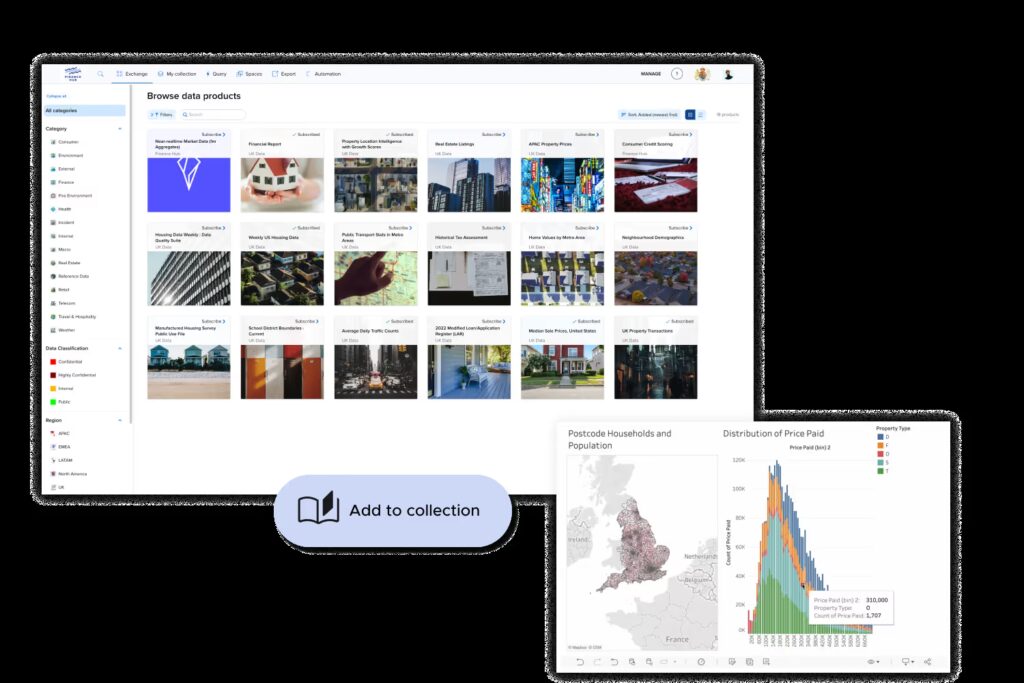
A home for your data products
External users interact through a white-labeled interface where available data is clearly presented. Depending on the policies set by the data owner, access can be self-service or via an approval process.
Govern
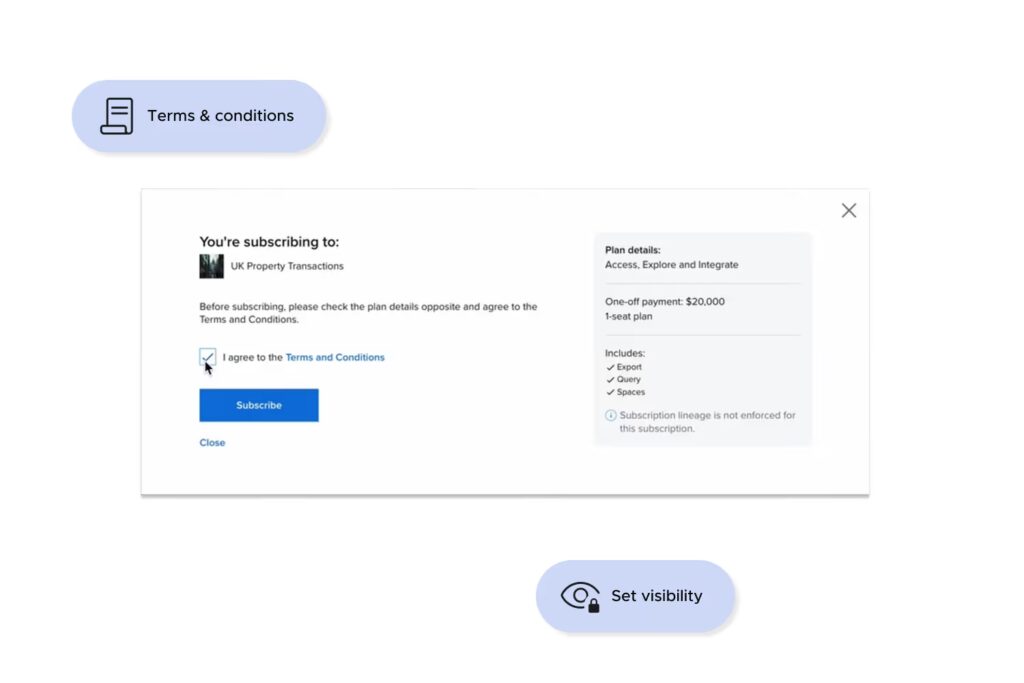
Self-enforcing data subscriptions
Access is governed through subscription-based entitlements defined by the data owner. These rules determine what can be accessed, under which conditions, and are applied consistently across all sharing methods.
Share
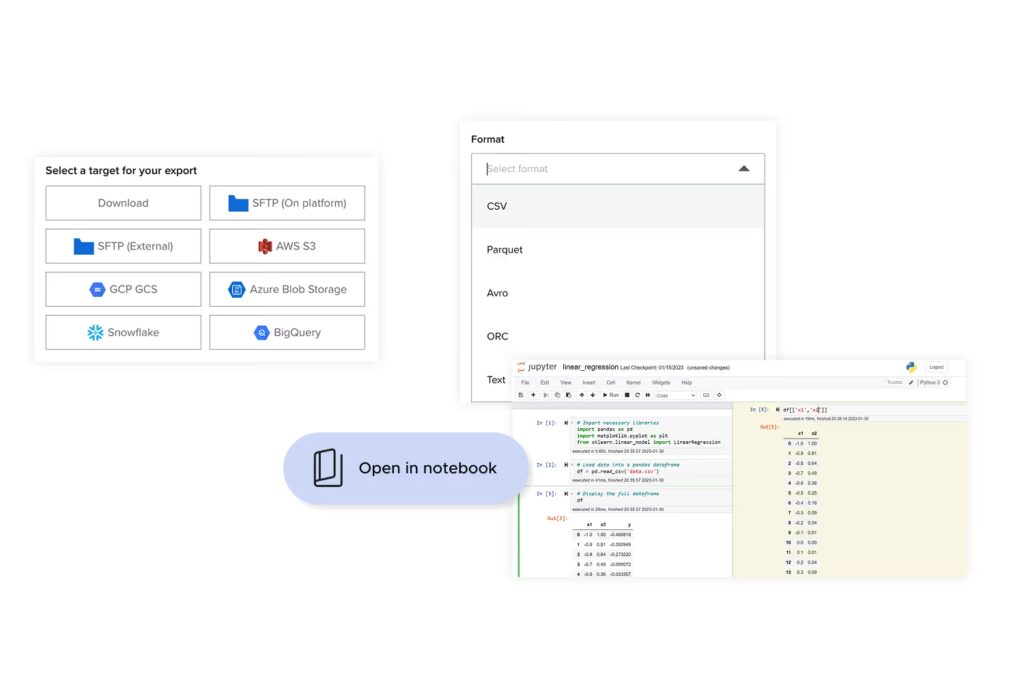
Securely share data & models
Approved access is enforced across existing systems. Data can be delivered to external environments, or made available in secure sandboxes. Harbr orchestrates access without forcing data to be moved or duplicated.
Audit
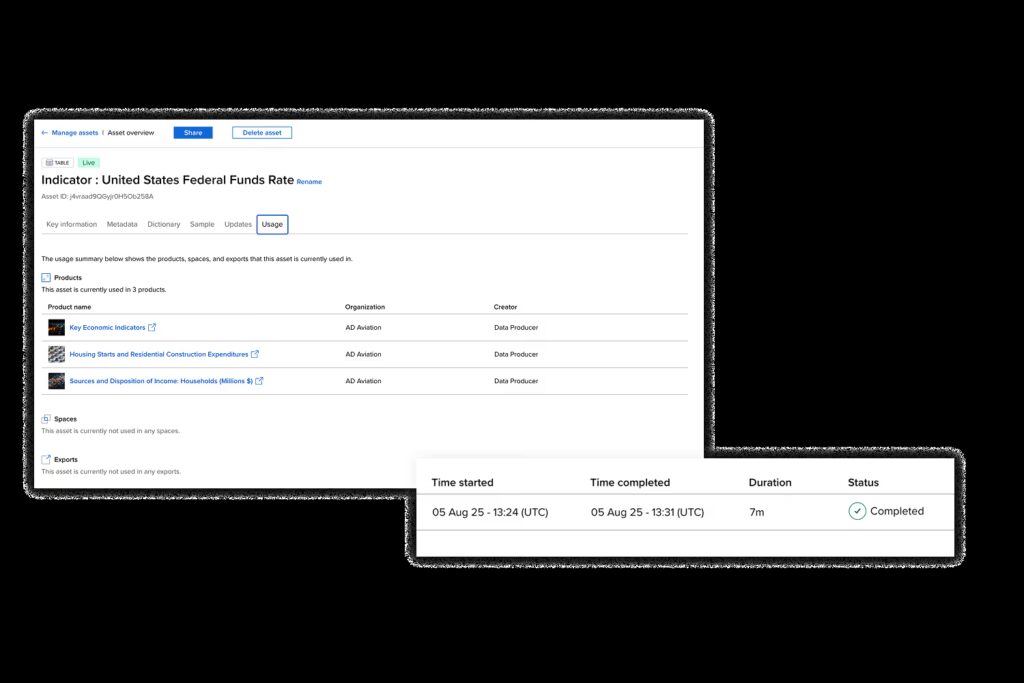
Full oversight of external data access
All external access is logged and traceable. Teams have a single system of record showing who accessed what data, when, how, and under which entitlement.
How do my customers access my Harbr platform?
Harbr platforms are accessed through any modern web browser. Depending on your setup, your customers can access your Harbr with either dedicated login credentials, or through single sign-on (SSO).
Is my Harbr platform publicly accessible?
Access to your Harbr platform is controlled by you. You may choose to have a public website where prospective customers can request access to your platform. A good example of this is Moody’s DataHub, which is built on Harbr.
What's the difference between a data marketplace, a data exchange, and a data distribution platform?
A data marketplace is the sell pattern: you bring multiple providers and consumers together in one governed environment, where each provider controls their own products, pricing and who consumes them, monetized or free.
A data exchange is the share pattern: multiple participants who each both provide and consume, collaborating under one perimeter to unlock value none of them could realise alone.
A data distribution platform is the distribute pattern: continuous, automated delivery of data products out to any number of consumers in their own environment, through export pipelines and zero-copy shares, so you’re not serving each consumer by hand.
Harbr’s technology powers all three, with the same governance and audit underneath. You choose which operating pattern suits your providers and consumers.
Can data providers set their own access and usage terms?
Yes. Each provider packages their own products and keeps control of them, even in an environment they don’t operate. They decide who sees what, they grant precise rights (access, query, export, data sharing or a secure Space – each switched on separately). They set subscription terms, pricing, and whether access is perpetual or fixed-term, along with the terms and conditions consumers accept on subscribing. All of this sits inside the perimeter and commercial templates you set as the operator.
Where is data physically stored, and can we control data residency for regulatory reasons?
You have the choice of storage. You can leave data at source and let Harbr orchestrate governed access to it, or bring a copy into Harbr’s platform-local storage. Either way, it sits within your own cloud account and region.
The platform deploys single-tenant into your environment, and Harbr’s application layer has no access to your data assets. So residency follows your environment, and you keep custody of your data and IP.
Can multiple teams within our organization manage different parts of our platform independently?
Yes, and the model is built for exactly this kind of delegated control.
You set the perimeter and standardize the commercial rules across the environment, while each provider runs their own products, permissions and subscriptions independently, without becoming dependent on a central team to configure everything for them.
Internal teams can be modelled as separate providers in the same way external ones are, each controlling their own corner.
Do AI agents get the same governance and access controls as human users, or separate rules?
AI consumers get the same access controls and the same audit trail as human users, under one operating model.
Whatever a consumer is entitled to see and do, and whatever gets recorded, works the same way whether that consumer is a person or an AI. There’s no separate set of controls to manage.
Is there a library of pre-built connectors, or is each integration custom-built?
Our technology includes a library of pre-built connectors, so integrations aren’t custom-built each time.
They cover common cloud storage and warehouses. That includes:
• S3
• GCS
• Azure Blob Storage
• BigQuery
• Snowflake
• Oracle
• OneLake
• MSSQL
• Databricks
• MySQL
• Postgres
• DB2
• Synapse.
• SFTP
• Power BI
• Looker
Assets can be registered and left at source, or copied into Harbr’s storage.